


Unique Blades Runner
Japanese Kama Sickle – Handmade Traditional Curved Blade with Wooden Handle
Japanese Kama Sickle – Handmade Traditional Curved Blade with Wooden Handle
- 14-day returns
- Ships from USA
- Trusted by 100,000+ customers
- 99% customer satisfaction rating
Couldn't load pickup availability
MADE IN THE USA
Proudly made in the USA with attention to materials, workmanship, and finish.
HEAT TREATED
Each blade is put through a rigorous heat treat process and quality performance test.
LIFETIME WARRANTY
We warranty each UBR knife to be free from defects and workmanship for the life of the knife.
Custom Orders
Custom Orders
Looking for a custom-made knife? We can work with your preferred blade style, size, steel, handle material, engraving, and sheath options.
📩 Request a Custom Order with your design idea, reference image, or requirements for pricing and availability.
Care Instructions
Care Instructions
Keep your handmade knife clean and dry to help preserve its finish and condition.
◆ Cleaning: Wipe the blade clean and dry after handling or use.
◆ Oiling: Apply a light coat of mineral or camellia oil before storage, especially on carbon and tool steels.
◆ Moisture: Avoid prolonged exposure to water or damp conditions.
◆ Storage: Store the knife and leather sheath in a cool, dry place.
◆ Avoid Soaking: Do not place the knife in a dishwasher or soak it in water.
Note: Care requirements may vary depending on the blade steel, handle material, and finish of the individual product.
Shipping Information
Shipping Information
We ship worldwide with tracking and protective packaging.
◆ Processing: Standard orders usually ship within 4–7 business days.
◆ Delivery: Transit times vary by destination and carrier.
◆ Tracking: Tracking details are provided after dispatch.
◆ Customs: International buyers may be responsible for applicable import duties or taxes.
For questions about an order or delivery, please contact us.
Disclaimer
Disclaimer
All our blades are individually handcrafted
- Our products are intended for collectors, chefs, and outdoor users
- Not designed for harm or misuse of any kind
- Must be used responsibly and in accordance with local laws
By purchasing, you acknowledge understanding and acceptance of our terms.


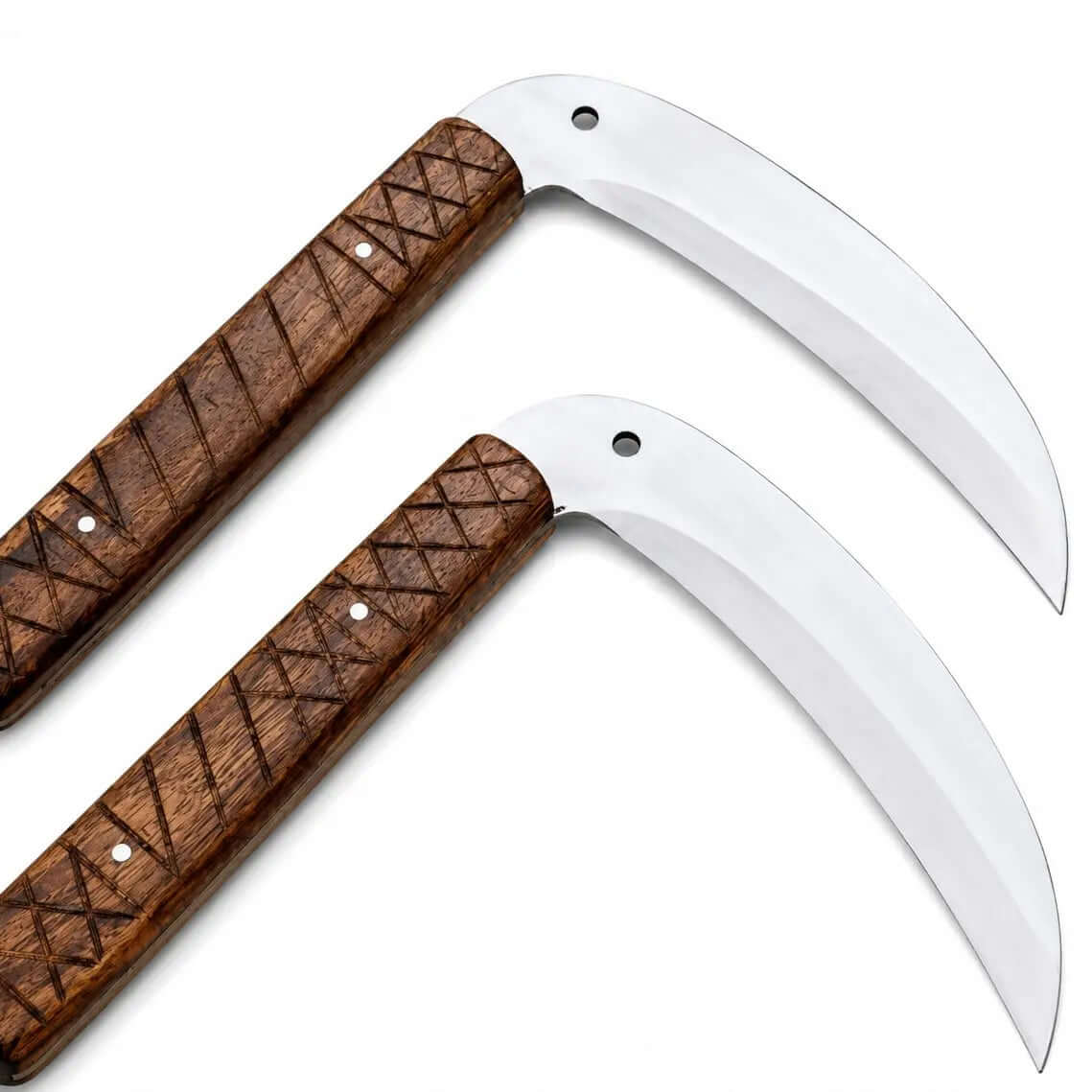
Japanese Kama Sickle – Handmade Traditional Japanese Curved Blade
Japanese Kama Sickle brings the recognizable form of the traditional Japanese hand sickle into an artisan-made piece defined by its curved blade and straightforward wooden handle. Known simply as a kama in Japan, this style has deep roots as an agricultural cutting tool used for harvesting crops, clearing vegetation, and other field work. Its distinctive inward-curving profile, traditional sickle form, handmade construction, and Japanese heritage make this piece appealing to collectors of historical tools, traditional blades, and blacksmith-made craftsmanship.
Traditional Japanese Kama Sickle Design
The Japanese Kama Sickle is immediately recognizable by the relationship between its compact handle and pronounced curved cutting profile. Traditional kama and te-gama, or hand sickles, were produced in several forms for agricultural work, including rice harvesting and vegetation cutting, with the cutting edge typically positioned along the inside of the curve.
That functional heritage gives this handmade kama a character quite different from a conventional straight fixed blade. The wooden handle keeps the appearance simple and historically grounded, while the curved blade creates the classic silhouette associated with a Japanese farming sickle, rice sickle, and traditional hand-harvesting tool.
Japanese Agricultural Heritage and Kama Tradition
Long before the kama became familiar to enthusiasts of traditional Japanese and Okinawan arts, it was fundamentally associated with agricultural work. Historical examples and surviving terminology connect the sickle with harvesting rice and cutting crops, while Japanese regions developed their own traditions of forged agricultural sickles.
The craft itself also has meaningful connections with Japanese metalworking history. Echizen, for example, preserves a centuries-old tradition of sickle making, with local accounts tracing forged sickle production back to the Kamakura period. This broader heritage gives a handmade Japanese sickle additional interest for buyers drawn to traditional Japanese tools, forged metalwork, and historic agricultural designs.
Handmade Curved Blade with Wooden Handle
Rather than presenting the polished uniformity of mass production, this Japanese Kama Sickle emphasizes an artisan-made character. The combination of a shaped curved blade and natural wooden handle reflects the uncomplicated construction historically associated with the kama form.
Produced by skilled artisans backed by more than 20 years of experience in handmade and forged goods, the piece is suited to enthusiasts who appreciate visible craftsmanship and traditional blacksmith-inspired construction. For collectors, the appeal comes from the recognizable profile, cultural background, and handcrafted appearance working together in one distinctive design.
A Distinctive Piece for Traditional Tool Collectors
For someone searching for a handmade kama sickle, traditional Japanese curved blade, Japanese harvest sickle, or wooden-handle sickle, this design offers considerably more personality than a generic modern garden tool.
It can also complement collections centered around Japanese craftsmanship, historical farming implements, heritage metalwork, Asian traditional tools, or unusual artisan-made blades. The compact wooden grip and dramatic curved profile give it strong display presence while maintaining the visual identity that defines the original kama.
FAQ About Japanese Kama Sickle
What does “kama” mean in this product's name?
Kama (鎌) is the Japanese term for a sickle, traditionally associated with agricultural cutting and harvesting tools.
Is this Japanese Kama Sickle based on a traditional farming tool?
Yes. The Japanese Kama Sickle draws its form from the traditional Japanese hand sickle used historically for tasks including crop and rice harvesting.
What makes the curved blade design distinctive?
The inward-curving blade creates the characteristic kama profile and separates it visually from straight-edged fixed-blade designs.
Why would collectors be interested in a handmade kama?
It combines Japanese agricultural heritage, recognizable traditional-tool styling, wooden-handle construction, and artisan craftsmanship in an unusual collectible format.
Is a kama connected with Okinawan kobudo?
The agricultural kama was also incorporated into Okinawan kobudo traditions, where specialized forms are commonly practiced in pairs. This Japanese Kama Sickle, however, is presented around the traditional sickle design and handmade craftsmanship rather than making claims of a specific historical training model.
For buyers drawn to traditional Japanese metalwork and recognizable heritage designs, the Japanese Kama Sickle offers a compelling combination of curved-blade identity, wooden-handle simplicity, historical inspiration, and handmade character.