Choosing a Handmade Chisel Set for Woodworking and Carving
A chisel set gives you several widths and edge shapes in one go, so you can match the tool to the cut instead of forcing one chisel to do everything. The right set depends mostly on the work. Carvers need curved and V-shaped edges to scoop, outline and add detail. Furniture makers and joiners need flat chisels to chop, pare and square up joints. The sets here cover both sides of that line, with carving sets built around mixed edge shapes and woodworking sets built around flat, straight edges.
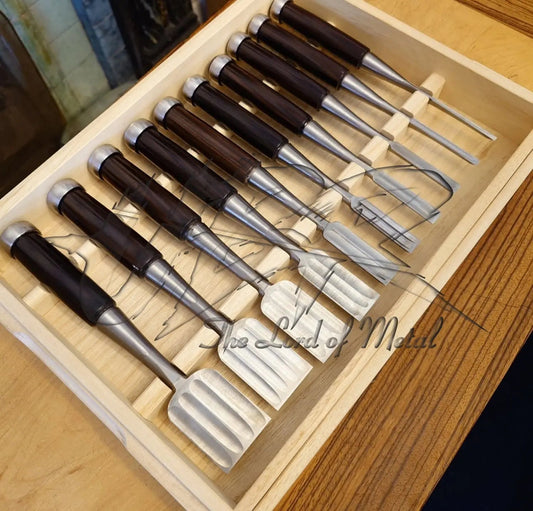
Wood Carving Chisel Sets: Gouges, V-Tools and Flat Chisels
A wood carving chisel set mixes edge profiles so one roll covers roughing out, shaping and finishing details.
Gouges
A gouge has a curved cross-section. The depth of that curve, called the sweep, decides how it cuts: deep sweeps hollow out bowls and remove waste quickly, while shallow sweeps smooth broad surfaces and soften transitions. Gouges are the workhorses of relief carving, spoon carving and sculpting in wood.
V-tools
Also called parting tools, V-tools have two flat edges meeting at an angle. They cut clean grooves for outlines, lettering, borders and fine texture such as hair, fur or feathers.
Flat carving chisels
Flat chisels set in straight lines, level backgrounds and crisp up the edges a gouge leaves behind. Our hand-forged wood carving chisel set pairs all three edge shapes with a leather roll that keeps the edges from knocking together in storage.
Woodworking Chisel Types for the Bench
Flat woodworking chisels come in several patterns, and knowing them helps you judge what a set will handle:
- Bevel edge (bench) chisels have beveled sides that reach into tight corners such as dovetails. They are the most common all-round woodworking chisel and take light mallet taps.
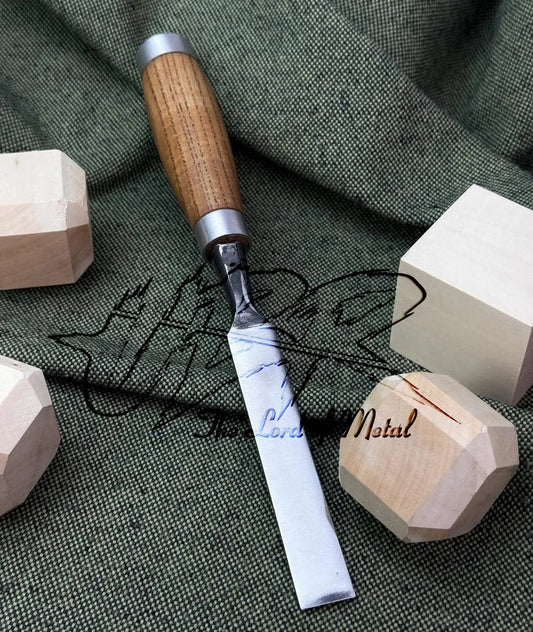
- Firmer chisels have square sides and a sturdier blade, suited to general chopping and heavier work.
- Mortise chisels are thick and square-sided, made to be driven deep with a mallet and levered to clear waste from a mortise.
- Paring chisels are long and thin, pushed by hand only for fine shavings and fitting joints. They should never be struck.
When comparing sets, look at the range of widths. A spread of narrow to wide blades lets you fit the chisel to the joint rather than cutting a wide recess with a narrow tool.
High Carbon Steel vs Damascus Steel Chisels
Most chisels in this collection are hand-forged from high carbon steel and heat-treated. High carbon steel takes a keen edge and comes back quickly on a sharpening stone, which is why it has been the traditional choice for edge tools. The trade-off is rust: it needs to be wiped dry after use and given a light coat of oil.
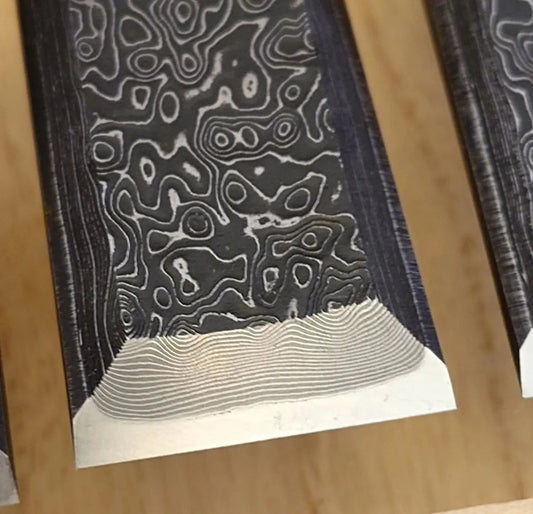
Damascus chisels are forged from layers of different steels welded together, then etched to reveal the flowing pattern. They cut and sharpen much like the steels they're made from, and many woodworkers choose them as much for their looks as for bench use. If you like that pattern on blades, our Damascus knives show the same layered steel. Because Damascus usually contains carbon steel, it needs the same dry storage and oiling.
Sharpening and Caring for Your Chisels
A new chisel performs best once its back is flattened and polished near the edge, since that flat face guides every cut. Bench chisels are commonly ground at around 25 degrees with a slightly steeper honed bevel, while paring chisels are often kept lower for finer slicing and mortise chisels steeper for strength. Light, frequent honing keeps an edge working far longer than waiting until it's dull.
Carving gouges and V-tools need shaped slip stones or a profiled strop to hone the inside of the curve. Drive struck chisels with a wooden or soft-faced mallet rather than a steel hammer to protect the handles, and store each set in its roll or case in a dry place.
Forged Tools for the Workshop and for Gifting
A handmade chisel set sits naturally alongside other hand-forged tools in a workshop, and it makes a practical present for a carver or woodworker. For more ideas, browse our handmade gifts, or look closer at the handmade Damascus steel chisel set. Compare the edge shapes and steels above, then choose the chisel set that fits the way you work.