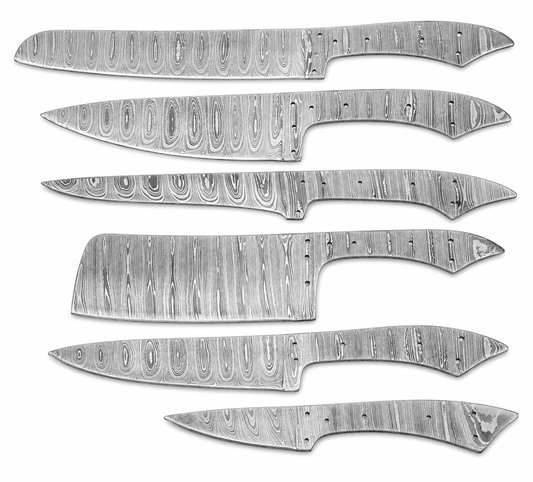
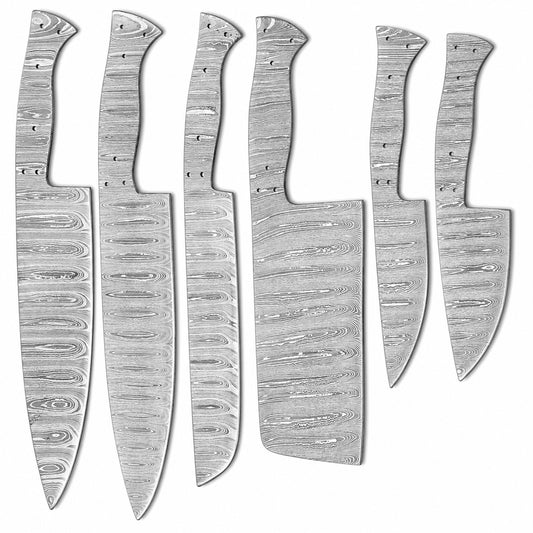
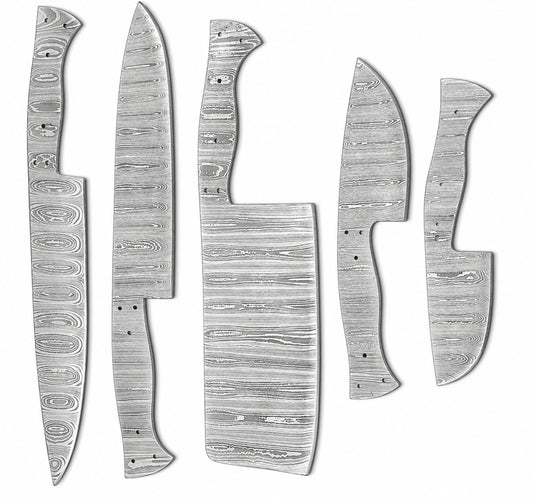
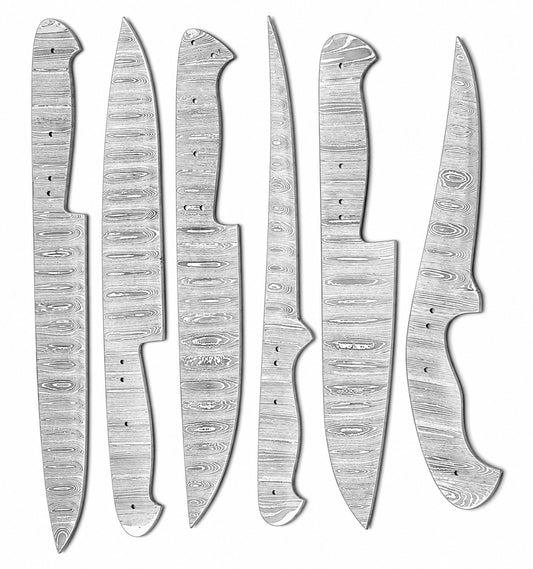
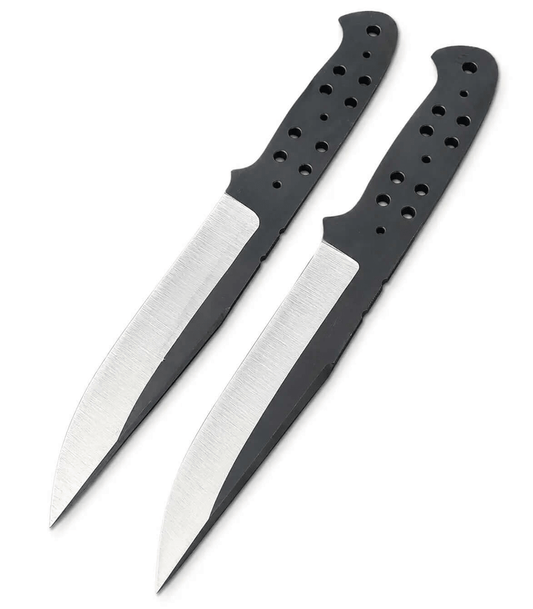
Heat Treated Knife Blanks for Knife Making
A knife blank is a blade that has been cut to shape and hardened but not yet finished. Starting from a blank skips the slowest and most equipment-heavy stages of knife making, such as profiling the steel and heat treating it, and leaves the parts that make a knife your own: the final grind, the edge, the handle and the finish. That makes blanks a practical starting point for first-time makers and a time saver for experienced makers who want to focus on handles and fit.
Every blank in this collection is heat treated, and the listings give the approximate hardness. The Damascus blanks are around 56–58 HRC, the 1095 blanks around 57–59 HRC and the D2 blanks around 58–60 HRC. Heat treatment is the step that decides how well a blade holds an edge, so buying blanks already hardened removes the biggest technical risk of a first build.
Damascus Steel Knife Blanks
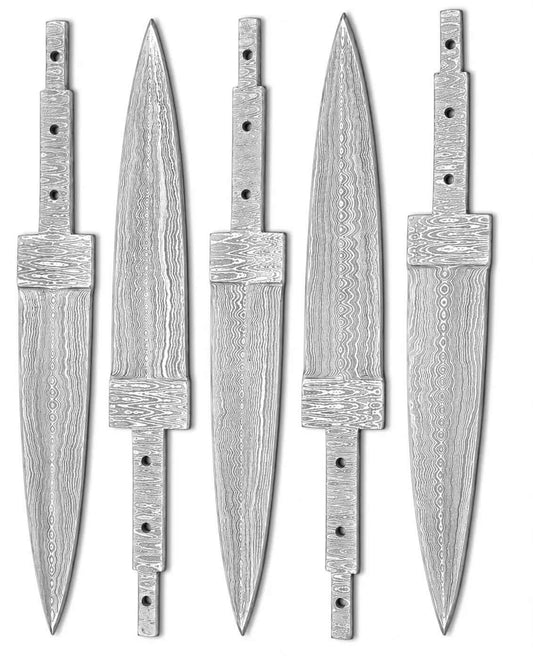
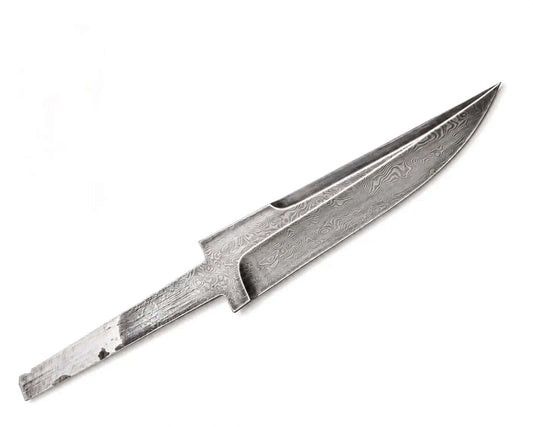
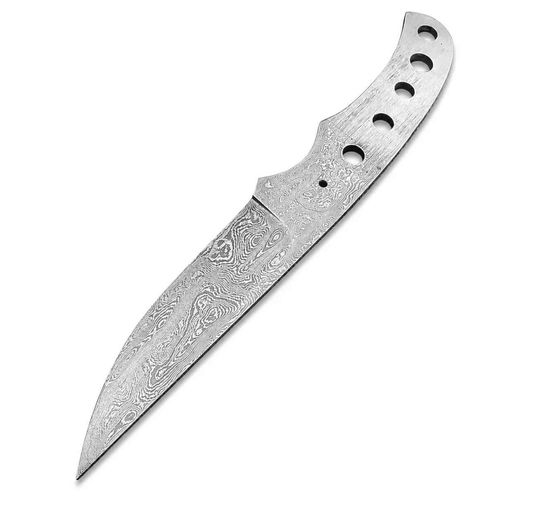
Damascus makes up most of this collection. Damascus is pattern-welded steel, built from layered steels, and its pattern shows once the blade is etched and finished. The pattern on these blanks runs through the blade and, on several of them, continues onto the tang, so it stays visible however you shape the handle. You'll find Damascus blanks in kitchen sets with chef, cleaver, slicing, fillet-style and utility profiles, hunting blades on full tang and hidden tang, a set of seax blanks and two sets of double-edge blanks. For the full range, see our Damascus knife blanks.
Damascus blanks suit makers who want a decorative finished knife. After final sanding, an acid etch, often in ferric chloride, brings out the contrast between the layers. Because Damascus contains carbon steel, the finished blade needs to be kept dry and lightly oiled.
D2 and 1095 Carbon Steel Knife Blanks
For a working knife with a plain steel finish, D2 and 1095 are the two most common choices, and they behave quite differently.
D2 Tool Steel Blanks
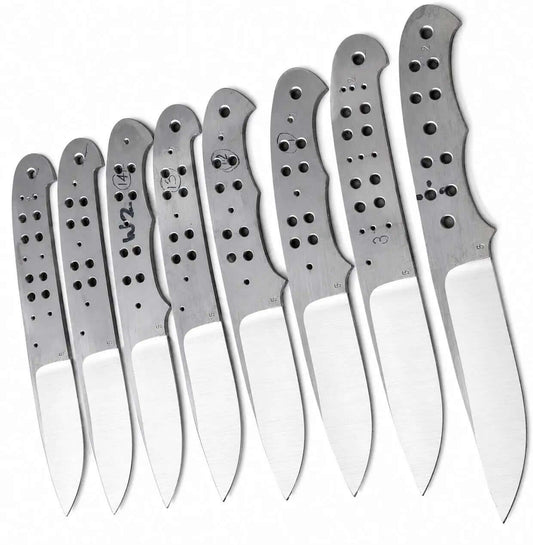
D2 is a semi-stainless tool steel with high chromium content. It resists rust better than plain carbon steel and holds an edge for a long time, which makes it popular for hunting and skinning knives. The trade-off is that it takes more effort to grind and sharpen. The D2 blanks here are full tang drop point hunting blades with a satin finish.
1095 High Carbon Steel Blanks
1095 is a simple high carbon steel that takes a keen edge and is easy to sharpen, by hand or in the field. It needs more care against rust than D2, but many makers prefer it for its easy maintenance on a working edge. The 1095 knife blanks here are full tang drop point hunting blades. For more plain carbon options, including mixed and hunting sets, see our carbon steel knife blanks.
Hunting, Kitchen and Specialty Blank Profiles
The profile decides what the finished knife will be best at. Hunting knife blanks, with drop point and skinning shapes, are the most popular choice for outdoor knives, and our hunting knife blanks collection brings those together. Kitchen blanks cover chef, slicing, cleaver, fillet-style and utility shapes, and work well as a matched set for a full kitchen build. Specialty profiles, like the seax, a historic Northern European single-edge blade, give makers a traditional pattern to work from.
Other profiles that suit blank-based builds include Bowie blanks with a long clip point, compact skinners, bushcraft and Scandi-style blades, and Japanese kitchen shapes such as the gyuto, santoku and nakiri. For Bowie builds, see our Bowie knife blanks.
Full Tang vs. Hidden Tang Blanks
The tang is the part of the blank that becomes the handle, and it decides how you'll build the grip.
A full tang blank runs the full length and width of the handle. You attach two handle scales, one on each side, usually secured with pins through holes in the tang and epoxy. Full tang knives are strong and simple to assemble, which is why most first builds use them. Several blanks here come with pin holes already drilled.
A hidden tang blank has a narrower tang that runs into a solid handle block, such as wood, antler or stacked material. The steel is hidden inside, which allows rounded, traditional handle shapes. Hidden tang builds take more drilling and fitting, but give a classic look. A narrow tang works the same way and suits slim or traditional designs.
Sets and Bulk Lots
Blanks here are sold as sets and lots, from pairs and small sets to 50-piece Damascus lots. Small sets let a maker try several profiles or build a matched group of knives. Bulk lots suit knife shops, makers who sell finished knives, workshops and teaching groups who need consistent blanks in quantity. Check the quantity, sizes and tang on each listing, because sets can mix profiles while lots usually repeat one design.
Finishing a Knife Blank
Most blanks are finished in the same order. First, refine the bevels and grind with files, a belt grinder or sanding by hand, keeping the steel cool so you don't affect the heat treatment. Next, hand-sand the flats to the finish you want, then etch Damascus to reveal the pattern if needed. Fit the handle scales or handle block, glue and pin them, then shape and sand the handle. Finally, sharpen the edge and add a protective coat of oil. A few basic tools are enough for a full tang build, which is why blanks are such a common way to start making knives.
Storing Knife Blanks
Carbon steel and Damascus blanks can rust before they're finished, so store them dry and add a light coat of oil if they'll sit for a while. Keep blanks separated in a lot so the edges and flats don't scratch each other. Browse the knife blanks above and compare steel, profile, tang and quantity to plan your next build.