How an Ulu Knife Works
An ulu works differently from any straight kitchen knife. The handle sits directly above a crescent-shaped blade, so your hand pushes straight down over the edge and the curve does the cutting as you rock it back and forth. That rocking motion centers force over the middle of the blade and holds food in place, which is why an ulu is easy to use with one hand and so effective for chopping. There's no point to catch and no slicing stroke to learn, so the ulu feels natural to most cooks after a few minutes.
The design has deep roots. The ulu is the traditional all-purpose knife of the Inuit, Iñupiat, Yupik and Aleut peoples of the Arctic, often called the "woman's knife." Early ulus had slate blades with handles of antler, horn, bone, ivory or wood, and steel blades replaced stone after contact with whalers in the 19th century. The shape has barely changed because it works.
Damascus Steel Ulu Knives
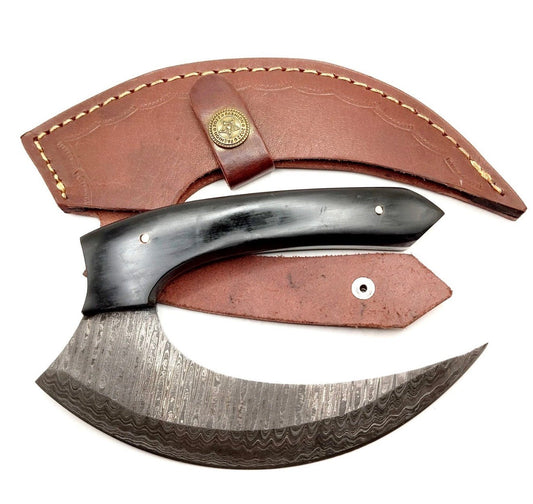
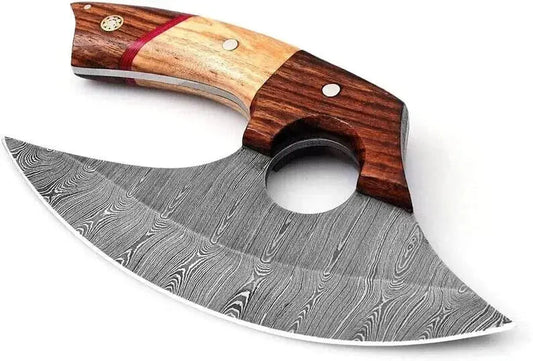
Most ulus in this collection have Damascus steel blades. Damascus is pattern-welded steel built from layered steels, and the crescent of an ulu shows that pattern especially well, because the wide, curved blade gives the layers room to flow across the steel. That makes a Damascus ulu a kitchen tool and a display piece at the same time.
Because Damascus contains carbon steel, it needs a little more care than stainless: dry the blade right after washing and give it a thin coat of food-safe oil now and then. In return, it takes a keen edge and keeps its pattern for years.
Alaskan Ulu Knives
The Alaskan ulu is the style most people picture: a half-moon blade with the handle mounted above it. Several handmade ulus here pair a curved Damascus blade of about 5.5 inches with a wood handle, a compact size that works on any cutting board. They suit everyday jobs such as chopping herbs, onions, garlic and nuts, slicing cooked meat, and cutting pizza or flatbread with a single rocking pass.
Handle Styles: Iñupiat and Canadian
Ulus are built in two main handle styles. In the Iñupiat (Alaskan) style, the blade joins the handle at both ends, which gives a stable, closed grip. In the Canadian style, a single central stem connects the blade to the handle, leaving more open space and a slightly different balance. Both cut the same way, so the choice comes down to how the grip feels in your hand.
Mini, Round and Specialty Ulus
Not every ulu is a standard crescent. A mini ulu has a smaller blade and shorter handle for herbs, garlic and small jobs, and it's easy to store or carry, especially with a leather sheath. A round ulu has a more fully curved blade for heavier chopping and butcher-style work on the board, and the one here comes with a leather edge cover. There's also a Damascus ulu with a stag horn handle, which adds natural texture and a traditional look that echoes the antler and horn handles of early ulus. See the Damascus ulu with stag horn handle.
Other variations worth knowing include larger ulus for big cuts of meat and fish, ulus sold with a matching wooden bowl or board shaped to the curve of the blade, and decorative ulus with carved or engraved handles. Whichever you choose, the same points matter: blade length, how much curve the edge has and how the handle sits in your hand.
Ulu vs. Mezzaluna, Chef Knife and Pizza Cutter
The ulu is often compared with the Italian mezzaluna, which also rocks on a curved blade but usually has handles at both ends and is used with two hands. An ulu needs only one hand, which leaves the other free to steady food. Compared with a chef knife, an ulu is faster for chopping and mincing but less suited to fine slicing or detailed cuts. And for pizza or flatbread, an ulu cuts cleanly through crust and toppings in one rocking pass. For a dedicated tool, see our pizza cutters, and for more chopping blades, our chopping knives.
Handles and Sheaths
Wood is the most common handle in this collection, and it gives a warm, comfortable grip that suits a tool you'll use often. Stag horn adds a natural, traditional character. Many ulus here include a leather sheath that covers the curved edge, which protects both the blade and your hands in a drawer. Keep leather sheaths dry, and store the ulu out of the sheath if it will sit for long periods.
Caring for an Ulu Knife
Hand-wash your ulu and dry it immediately. Dishwashers can damage both the Damascus steel and the wood handle. Oil the blade lightly to keep rust away, and treat wood handles with food-safe oil from time to time so they don't dry out. To sharpen, work along the curve with a sharpening rod or a small stone, following the arc of the blade rather than holding it straight. A well-kept ulu will stay sharp and good-looking for years. Browse the ulu knives above, or see our full range of kitchen knives.