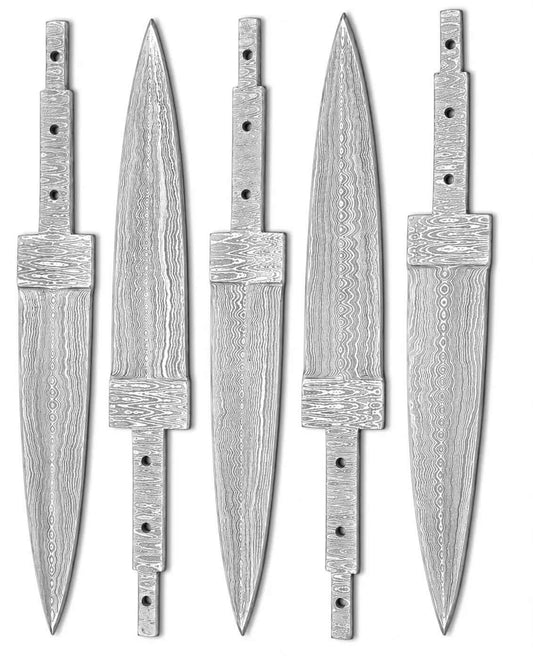
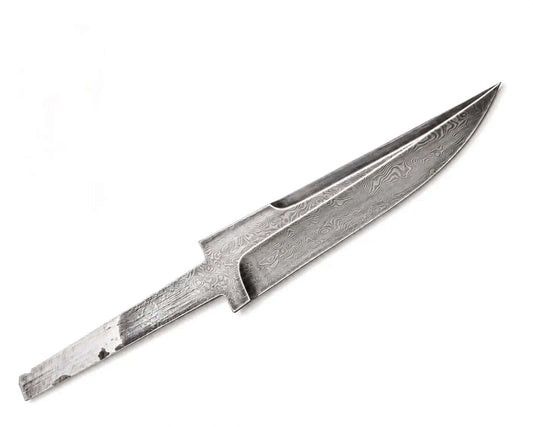
What Makes a Knife Blank Hidden Tang
A hidden tang blank has a narrow tang that runs into the handle instead of lying flat along its outside edges. You drill or broach a channel in a single block of handle material, slide it over the tang and secure it with epoxy and an end cap, pommel or peened tang. The result is a knife with a smooth, continuous grip, which suits stag, antler, solid wood and stacked materials. Handles, guards, pins and sheaths are not included unless a listing says so, so plan those parts alongside the blade.
Hidden Tang vs Full Tang Blanks
A full tang blank has a tang the same outline as the handle, drilled for pins, so you fit two scales, one on each side. It is the simpler build, and you can see the fitting as you work. A hidden tang blank takes more care. The channel must be straight and the guard must sit square to the blade, but it allows round, carved or one-piece handles that scales cannot give you. If you want the scale-and-pin route, see our full tang knife blanks.
Hidden Tang Blanks by Knife Type
Hunting and skinning blanks
Hidden tang is a traditional build for hunting knives. A one-piece handle in stag, antler or hardwood gives a classic outdoor look. The Damascus hunting blanks in this collection are heat treated and have a shoulder ahead of the tang for a guard or bolster. For other outdoor profiles, browse our hunting knife blanks.
Bushcraft and puukko-style blanks
Bushcraft and puukko-style knives are often built on hidden tang blanks with a simple, slim handle. These blades usually pair a straight spine with a Scandi-style grind, so check the grind before you order.
Kitchen and Japanese-style blanks
Hidden tang is the traditional build for Japanese-style kitchen knives such as the gyuto, santoku and petty. The handle is often octagonal or D-shaped, with a ferrule at the front. Use water-resistant handle materials and seal the joint with epoxy, because a kitchen knife meets water every day. Our kitchen and chef knife blanks cover finished-set builds.
Steel Choices for Hidden Tang Blanks
Steel decides how much care the finished knife needs. Damascus knife blanks are pattern-welded from layers of different steels, and the pattern shows most clearly after sanding and etching. It varies from one blank to the next. Stainless blanks in steels such as 440C or VG10 resist rust and suit knives that are washed often. High carbon steels such as 1095 sharpen easily but darken to a patina and need drying and light oiling. Check each listing for its confirmed steel and heat-treatment status.
Narrow, Rat Tail and Threaded Tangs
Not every hidden tang looks the same. A narrow flat tang is the most common style. A rat tail tang tapers to a thin rod and suits a handle with a long channel. A threaded tang ends in a thread so a nut can lock the handle on, which works well for stacked handles built from washers of leather, wood or other materials. The shape of the tang decides how the handle is secured, so match your fastening method to the blank you choose.
Fitting Guards and Handle Materials
Fit the guard first. It needs to sit at 90 degrees to the centerline of the blade and tang, even if the guard itself is slanted. Take your time with the slot, because a crooked guard shows in the finished knife. After that, drill or broach the handle channel to follow the tang, keeping both blade and tang straight. Solid blocks of wood or stag work well. Stacked builds in wood, antler or Micarta suit threaded or longer tangs. Epoxy fills any gap between steel and handle.
Bulk Hidden Tang Lots
Production runs, classes and workshops often need matching blanks, so some hidden tang blanks are sold in larger lots. See our knife blank lots for bulk options. Custom quantities, maker pricing and different steels can be arranged through the bulk enquiry on the product page.
What to Check Before You Order
Compare the tang length with the handle block you plan to use, since a hidden tang that is too short limits your handle options. Look at tang width and thickness, whether there is a shoulder for a guard, the overall and blade length, and the steel. Also confirm whether the blank is heat treated and whether the edge is sharpened or left for you. Compare the profiles above and choose the hidden tang knife blank that suits your handle design.