
Collection: Seax Knives
Seax Knives bring one of the most recognizable early medieval blade traditions into a collection created for shoppers who appreciate historical design, handmade craftsmanship, and distinctive collector pieces. Inspired by Anglo-Saxon and broader Germanic seax forms, these fixed-blade designs are known for their characteristic single-edged profiles, including straight-backed, broad-bladed, and broken-back seax styles. Our collection explores traditional seax knife character through artisan-made interpretations suited to historical collectors, Viking-age enthusiasts, reenactment-inspired displays, and customers searching for handmade historical knives. Individual designs may vary in blade profile, handle treatment, finish, size, and sheath style, giving shoppers the opportunity to compare different interpretations of the classic Anglo-Saxon seax while maintaining the strong visual identity associated with this historic blade family.
-
Forged Seax Knife with Antler Handle & Handmade Leather Sheath
Regular price $249.99 USDRegular priceUnit price / per

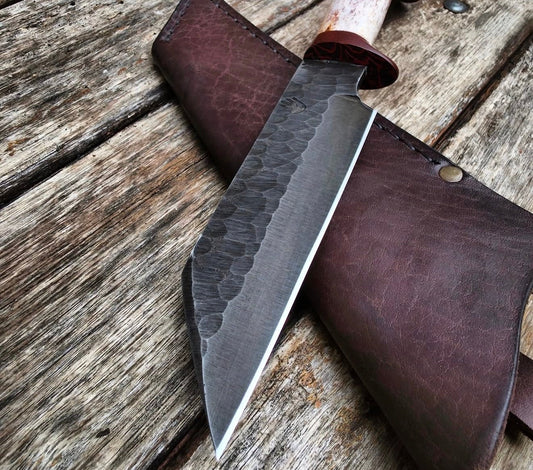
Seax Knives and the Distinctive Early Medieval Blade Tradition
Seax Knives are recognized by a design tradition closely associated with Anglo-Saxon and Germanic material culture. Historically, the word seax was an Old English term for a knife, while archaeologists commonly use it for larger single-edged iron knives found in Anglo-Saxon contexts. Surviving examples demonstrate that the seax was not one completely standardized shape; proportions, blade profiles, decoration, and construction varied considerably across periods and regions.
That variation is part of what makes the category interesting today. Shoppers may encounter names such as Anglo-Saxon seax, Viking seax, sax knife, broken-back seax, long seax, broad seax, historical seax knife, or handmade seax. Although these terms sometimes overlap in modern collecting, they can describe noticeably different interpretations.
One especially recognizable form uses a straight cutting edge with an angled or sharply sloping back approaching the point. Other historical examples have longer, narrower blades with the edge running almost parallel to the spine, while broad examples can feature curved backs and cutting edges. Museum collections preserve all of these variations, showing why a historically inspired seax collection can contain several distinct silhouettes rather than one repeated blade pattern.
Traditional Seax Styles and Blade Profiles
Broken-Back Seax Designs
The broken-back seax is among the most visually distinctive interpretations. Its profile typically features an angular transition along the spine that descends toward the point, creating the unmistakable geometry many modern shoppers associate with an Anglo-Saxon seax knife.
Historical evidence supports this characteristic form. Late Anglo-Saxon surviving examples include straight cutting edges combined with angled backs, demonstrating that this geometry has genuine archaeological precedent rather than being a modern fantasy convention.
For collectors, the broken-back profile often has immediate visual appeal because it differs clearly from common modern fixed-blade shapes. It works especially well for customers building historical displays or collections centered on Anglo-Saxon, Viking-age, medieval, and traditional European designs.
Broad and Long Seax Interpretations
Not every seax follows the dramatic broken-back silhouette. Historical classifications also include broad forms and long, narrow examples. The British Museum describes later seaxes that can be separated into long narrow blades with an edge nearly parallel to the back and shorter, broader forms with a sharply angled back.
This diversity gives Seax Knives considerable range as a collection. A customer may prefer a compact broad-bladed historical knife, while another may be drawn toward a long seax with an extended profile and stronger display presence.
Broad seax forms can also feature curved cutting edges and curved backs. A seventh-century example in the British Museum, for instance, survives with a broad iron blade and both back and cutting edge curving toward the point. Such historical variation provides a useful foundation for modern handmade interpretations without requiring every artisan piece to share identical geometry.
Historical Inspiration, Materials and Craftsmanship
Modern handmade seax designs take inspiration from surviving early medieval forms while allowing individual blacksmiths to interpret proportions, finishes, handles, and decorative details through contemporary craftsmanship.
Historical examples were primarily iron, and some show considerably more sophisticated decorative work than a plain blade might suggest. Surviving Late Anglo-Saxon pieces include pattern-welded construction, incised grooves, and copper or copper-alloy inlay. One ninth- to tenth-century example in the British Museum preserves chevron-patterned metal inlay and evidence of pattern welding.
Handles also varied. Archaeological examples preserve evidence of organic materials such as horn and wood, while traces of leather sheaths have survived with some finds. These details help explain why modern historical seax knives are often appreciated as complete artisan designs rather than simply for blade shape.
Within a handmade collection, specific materials may differ from one listing to another. Depending on the individual design, shoppers may encounter different steels, handle materials, surface finishes, decorative treatments, and leather sheath configurations. Checking each individual listing is the best way to compare exact construction and dimensions rather than assuming every seax uses the same specification.
Handmade production also means subtle differences can be part of the character. Grind lines, handle shaping, finishing, and other artisan details contribute to the appearance of a historical-inspired piece and distinguish it from uniformly mass-produced designs.
Choosing the Right Seax Knife for Your Collection
Choosing between Seax Knives is primarily about deciding which interpretation of the historical form appeals to you most.
Start with the blade profile. A broken-back seax offers sharp geometric lines and one of the most immediately recognizable Anglo-Saxon silhouettes. A broader profile creates a heavier visual appearance, while an elongated long seax emphasizes length and historical display presence.
Next, compare proportions. Seax designs can vary significantly in overall length, blade width, spine shape, point geometry, and handle length. Historical finds themselves show considerable variation, so there is no single dimension that defines every legitimate seax-inspired design.
Handle styling can also change the overall character of the piece. Simpler forms can create a restrained historical appearance, while more detailed artisan handles may suit collectors who prefer decorative craftsmanship. If a sheath is included with a particular listing, its construction and style can also contribute significantly to how the complete piece presents.
Finally, consider whether your priority is historical styling, handmade craftsmanship, collection variety, or display appeal. Someone developing a broader collection of medieval and historical knives may choose a seax that contrasts strongly with existing Bowie Knives or other fixed-blade styles. Customers interested specifically in historical craftsmanship may instead compare several seax profiles and build a collection around their differences.
Why Seax Designs Appeal to Historical Collectors
The appeal of the seax comes partly from its strong historical identity. Archaeological finds span several centuries of Anglo-Saxon material culture, with museum examples dating from the early Anglo-Saxon period through the ninth and tenth centuries.
For collectors, that heritage creates connections to early medieval craftsmanship, Germanic culture, Anglo-Saxon history, and the wider Viking-age world. Modern usage often labels some interpretations as Viking seax knives, although surviving archaeological classifications and regional terminology are more nuanced than a single modern category name.
The design also occupies a distinctive place in a mixed collection. Its long single-edged profile, angular or curved spine possibilities, and historic handle forms make it visually different from later European daggers and modern fixed blades.
That makes handmade seax designs relevant to historical enthusiasts, collectors of artisan blades, period-inspired displays, and customers simply drawn to unusual traditional craftsmanship. Related shoppers may also explore Collectible Knives or other historically inspired designs when building a broader collection.
Why Choose Unique Blades Runner
Unique Blades Runner focuses on handmade and artisan-made designs for customers who appreciate distinctive blade profiles, traditional influences, and individual craftsmanship. Backed by more than 20 years of craftsmanship experience, our work covers a wide variety of collector, historical, and custom-inspired designs.
The aim of this collection is to preserve the recognizable character that makes a seax immediately distinctive while offering shoppers different handmade interpretations rather than a single repeated design. Individual listings provide the specific dimensions, materials, finishes, handles, and sheath details needed to compare available pieces accurately.
For customers looking for something more individualized, Custom Orders may also be relevant where a particular historical profile, size, handle concept, or other design variation can be accommodated.
FAQ About Seax Knives
What is a seax knife?
A seax is a historical single-edged knife associated particularly with Anglo-Saxon and other Germanic cultures. Archaeologists use the term for numerous surviving blade forms rather than one single standardized profile.
Are seax knives the same as Viking knives?
The terms overlap in modern collecting, but they are not completely interchangeable. Seaxes are found across different Germanic and Anglo-Saxon contexts, so “Viking seax” is best understood as one popular modern search term for historically inspired designs rather than a description of every surviving seax.
What is a broken-back seax?
A broken-back seax has a spine that changes direction sharply and slopes toward the point. Historical Late Anglo-Saxon examples with straight cutting edges and angled backs provide archaeological evidence for this recognizable profile.
What materials are used in handmade seax knives?
Materials depend on the individual design. Modern pieces may use different blade steels, handle materials, finishes, and sheath constructions, so shoppers should check each listing for exact specifications rather than assuming the entire collection shares one material.
Are Seax Knives suitable for historical collections?
Yes. Seax Knives are particularly relevant to collectors interested in Anglo-Saxon history, Viking-age designs, early medieval craftsmanship, Germanic material culture, and artisan interpretations of historical blade forms.
Do all seax knives have the same blade shape?
No. Surviving examples include long narrow blades, broad forms, angled broken-back profiles, and examples with curved backs and cutting edges. Modern handmade designs can therefore reflect several genuine historical silhouettes.
Do seax designs come with leather sheaths?
This varies by individual listing. Leather has historical relevance—archaeological examples preserve traces of leather sheaths—but shoppers should check the specific product details to confirm whether a sheath is included with a modern handmade piece.
Explore Handmade Seax Designs
From angular broken-back profiles to broader and longer historical interpretations, Seax Knives offer collectors a category with considerable design variety and a clear connection to early medieval craftsmanship. Whether your interest is Anglo-Saxon heritage, Viking-age aesthetics, handmade historical knives, or distinctive artisan display pieces, comparing the different blade profiles, proportions, materials, handles, and finishes can help you find the interpretation that best fits your collection.