What Sets Russian Knife Designs Apart
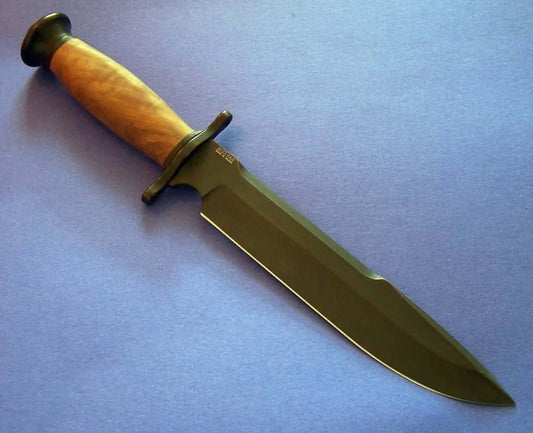
Russian fixed blades developed largely apart from American knife traditions, and it shows. Where a Bowie relies on a long clip point and a hunting knife on a gentle drop point, many Russian designs use a wide, leaf- or petal-shaped blade, a reinforced spine and a pronounced guard. Some add a curved hollow in the edge or a toothed spine, and handles often use stacked leather, birch or rubberized materials shaped for a firm grip in cold, wet conditions. The result is a family of knives that collectors recognize at a glance.
The knives in this collection are handmade replicas of those designs. They follow the original outlines, while steel, handle and finish are set by each listing, so it's worth comparing those details alongside the profile.
Antiterror Pattern Knives
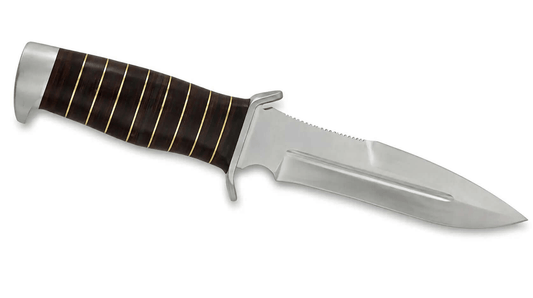
The Antiterror is one of Russia's best-known fixed blade designs, created by the knife maker Melita-K. It's built around a wide, petal-shaped blade with a reinforced spine. A crescent-shaped hollow in the edge adds cutting length without making the blade longer, and a pronounced guard keeps the hand from sliding forward. These features make it look very different from any Western pattern.
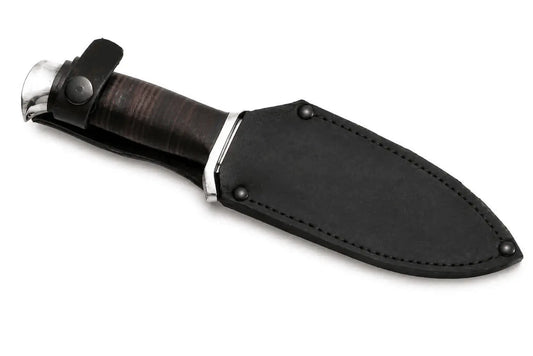
This collection includes Antiterror pattern replicas, and the D2 Antiterror pattern replica has a stacked leather handle with brass spacers and arrives sharp with a leather sheath. That version is slightly larger than the factory knife, which suits collectors who want a bolder display piece. D2 is a semi-stainless tool steel that resists rust better than plain carbon steel and holds an edge well, while stacked leather gives a warm, traditional grip that improves with handling.
Punisher Pattern Knives
The Punisher is another distinctive design associated with Melita-K. It has a broad, unconventional blade with strong visual character and doesn't follow the familiar lines of a Bowie or standard hunting knife. That outline is the reason collectors choose it, and it sits well beside an Antiterror pattern knife, since both show the same maker's very different approach to blade shape. The handmade Punisher replica here arrives sharp with a leather sheath.
DV-2 Pattern Knives
The DV-2 is a Russian fixed blade design known for its bold, rugged profile, and it's one of the most recognized Russian knife patterns among collectors. This collection includes a handmade DV-2 pattern knife and a limited edition version with a serrated back. The serrated spine is the main visual difference: it adds detail and texture along the back of the blade while keeping the familiar DV-2 outline. If you want one DV-2, compare the clean spine of the standard version with the toothed spine of the limited edition.
Traditional Russian Knife Patterns
Beyond modern designs, Russia has a long tradition of regional knives that collectors look for. Knowing them helps you understand where today's Russian fixed blades come from.
Yakut Knife
The Yakut knife comes from Yakutia in northeastern Siberia. Its blade is asymmetrical: one side has a fuller and a chisel grind, while the other side is convex down to the edge. The handle is traditionally birch burl, thick and egg-shaped in cross-section, with no guard, so it works well with gloves in extreme cold. It's a working knife used for woodworking, hunting, fishing and cutting frozen meat.
Finka
The finka is a Russian fixed blade descended from the Finnish puukko. It became widely popular in the Soviet era and is known for its slim blade, short guard and often a stacked handle. Its simple, practical shape makes it a good contrast to the broad modern designs above.
Zlatoust Engraved Knives
Zlatoust, a city in the Ural Mountains, has a long tradition of decorated blades, with engraved and etched steel, ornate guards and fine handle work. Zlatoust-style knives are chosen as collector and display pieces as much as working blades.
Steel, Handles and Sheaths
Russian-style knives use a wide range of materials, so check each listing for the steel on that knife. D2 tool steel, used on the Antiterror pattern replica here, gives good rust resistance and edge retention. Carbon steels sharpen easily but need oil to prevent rust. Stacked leather and birch handles follow traditional Russian practice, while other handle materials give a more modern grip. Several knives in this collection come with a leather sheath that protects the wide blade and suits these large fixed blades.
Caring for Russian-Style Knives
Wipe the blade dry after handling and oil it lightly, especially if it isn't stainless. Leather handles benefit from an occasional leather conditioner so they don't dry out or crack. Leather sheaths hold moisture, so store the knife out of the sheath for long periods, somewhere cool and dry.
More Collectible and Historical Knives
If you collect knives by country or tradition, our historical knives and collectible knives collections go further, and our Bowie knives show the Western large fixed blade tradition for comparison. Browse the Russian knives above and compare their profiles, spines and handles.