Choosing Kitchen Knife Blanks for a Custom Build
A kitchen knife blank is a shaped, handle-free blade. It saves you the profiling and leaves the personal work: the handle, the balance and the final edge. Kitchen blanks are thinner behind the edge than outdoor blanks, often around 2 to 3 mm, because they slice food rather than chop wood. That makes profile, grind and steel matter more here than on almost any other kind of blank. Handles, pins and sheaths are not included, so plan those parts alongside the blade.
Chef, Cleaver, Slicer, Fillet and Paring Blanks
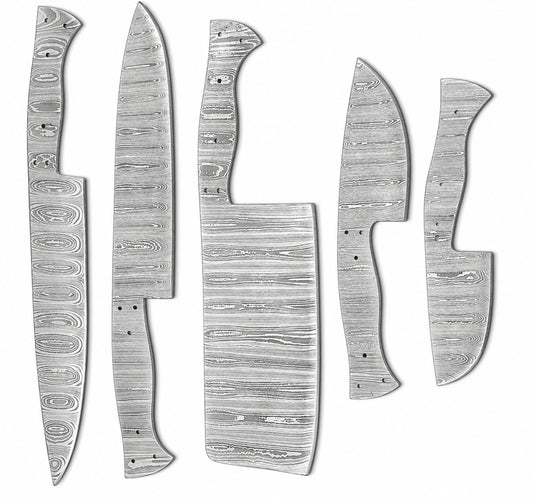
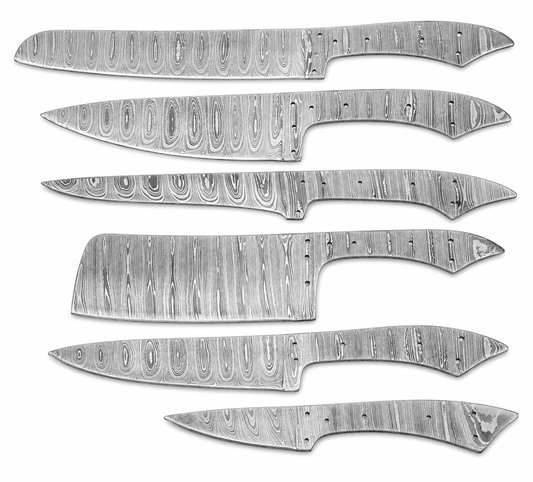
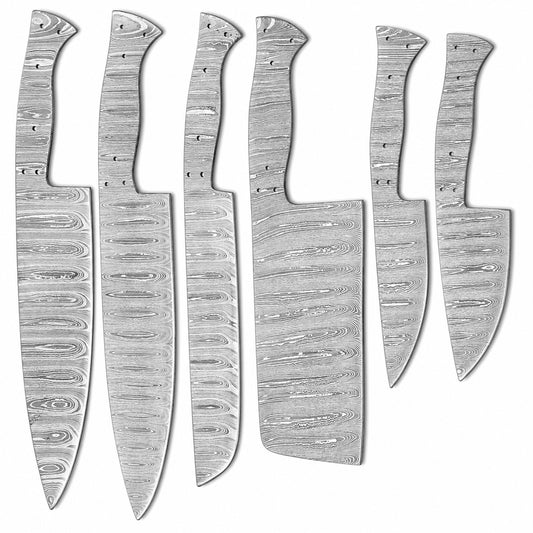
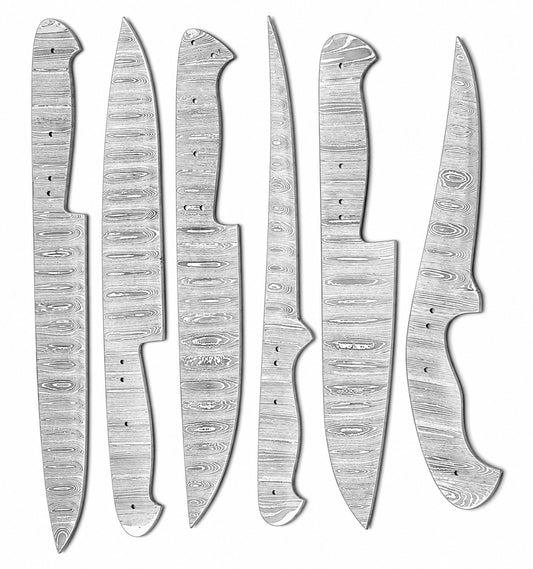
The Damascus sets in this collection are cut as kitchen lineups, so one order can cover several jobs at the board. Here is what each profile is for.
Chef knife blanks
A chef knife blank is the all-rounder. It has a curved belly for rocking through herbs and garlic, a pointed tip and enough height at the heel to keep your knuckles clear of the board. Western chef knives usually run 8 to 10 inches. If you only build one kitchen knife, start with this profile. A Damascus chef knife blank also shows its layered pattern along the broad flank.
Slicer and carving blanks
Slicers are long and narrow, so one clean stroke passes through a roast, brisket or side of fish without sawing. They need more handle length to balance, so check the tang before you choose scales.
Cleaver knife blanks
A cleaver blank is tall, heavy and rectangular, made for splitting joints and chopping through small bones. Its weight sits forward, so a handle with some heft keeps the finished knife from feeling blade-heavy. A vegetable cleaver is thinner and meant for produce only.
Fillet and paring blanks
Fillet knife blanks are narrow and thin so the blade can follow a fish frame. Paring knife blanks are small blades for peeling, trimming and work held in the hand. Both are common additions when you build a full kitchen knife blank set.
Japanese-Style Kitchen Knife Blanks
Japanese-style kitchen knife blanks suit makers who want a lighter, thinner knife. A gyuto is the Japanese chef's knife. It has a flatter belly and a finer tip than a Western chef knife, and it favors push and pull cuts over rocking. A santoku knife blank is shorter, at roughly 6.5 to 7 inches, with a flat edge and a rounded tip for vegetables, fish and boneless meat. A nakiri has a flat, square blade for chopping straight down to the board, and a petty is a small utility knife for trimming. Many Japanese-style builds use a one-piece handle on a hidden tang.
Boning, Bread and Table Knife Blanks
Specialist kitchen knife blanks fill out a set. Boning blanks are narrow and follow the bone, bread blanks carry a serrated edge, and carving blanks are long for slicing roasts. Steak knife blanks are usually bought in sets of four to six so the finished knives match at the table. Cheese and oyster blanks cover smaller jobs.
Damascus, Stainless and Carbon Steel for Kitchen Blanks
Steel decides how much care the finished knife needs, because a kitchen knife meets water, acid and salt every day. Damascus knife blanks are pattern-welded from layers of different steels and etched to bring out the pattern, which varies from one blank to the next. The Damascus sets in this collection are heat treated.
Some Damascus uses stainless layers and some uses carbon, so the care a finished knife needs depends on what is in the billet. Ask us if that decides your build. Stainless blanks in steels such as 440C or VG10 resist rust and staining from tomatoes, citrus and onions, which suits a knife that gets washed often. High carbon blanks such as 1095 take a keen edge and sharpen easily. They darken to a patina and must be dried straight after washing.
Full Tang and Hidden Tang Kitchen Blanks
The Damascus sets here are full tang knife blanks with pin holes drilled for handle scales. This is the usual build for a Western-style kitchen knife with two pinned scales, and it is straightforward to finish. Hidden tang blanks are the traditional choice for Japanese-style knives. They fit into a one-piece handle, often octagonal or D-shaped with a ferrule at the front, and give a slimmer, lighter grip.
Handle Materials for a Kitchen Knife
Choose handle materials that cope with water: stabilized wood, Micarta, G10 or resin. Fill every gap between handle and steel with epoxy so moisture and food can't work in, and wash the finished knife by hand rather than in a dishwasher.
Building a Matched Kitchen Knife Set
Many makers finish every blank in a set with the same handle material, which makes the knives read as one set at a glance. A practical set pairs a chef knife with a utility or petty knife and a paring knife, then adds a slicer, cleaver or bread knife later. To see how finished sets come together, browse our kitchen knife sets, chef knives and cleaver knives.
What to Check Before You Order
Look at blade length, height at the heel and thickness, since a thin spine and a thin grind behind the edge make a better slicer. Check whether the blank is heat treated, whether the edge is sharpened or left for you, and how many pin holes the tang has. If a listing doesn't answer something that decides your build, contact us before ordering. Compare the profiles above and choose the kitchen knife blank that fits the cooking you do.