What Makes a Knife Blank Full Tang
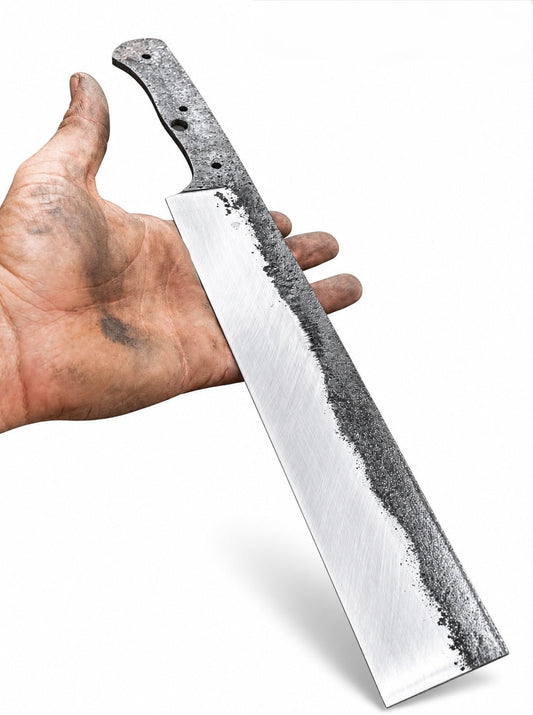
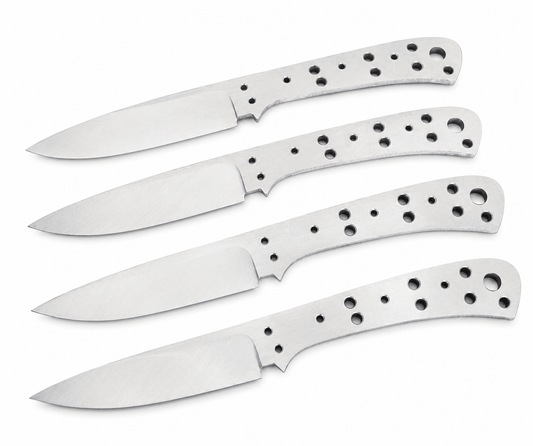
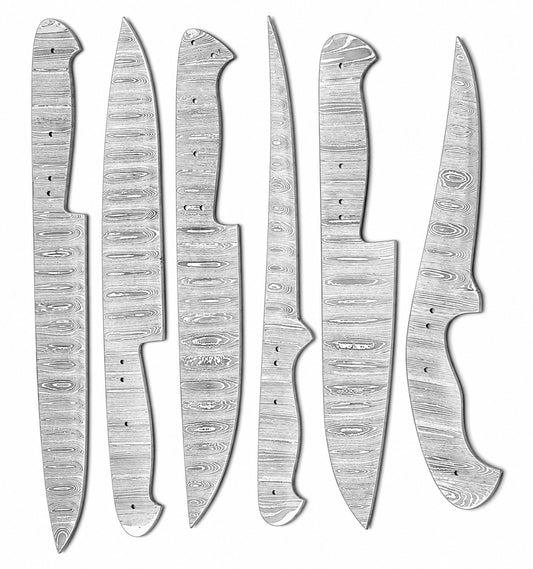
On a full tang blank, the tang (the part of the steel that becomes the handle) is a flat plate with the same outline as the finished grip. You fit a handle scale to each side, so the steel shows along the spine and belly of the handle like the filling in a sandwich. Because there's no narrow neck where the blade meets the handle, a full tang knife handles prying, batoning and heavy cutting well. That strength is why most hunting, bushcraft, camp and kitchen knives are built this way.
It's also the most forgiving build for a first knife. You don't need to drill a handle block or fit a guard. You shape two scales, glue them, pin them and sand them flush to the steel.
Full Tang vs. Hidden Tang Blanks
A hidden tang blank has a narrow tang that slides into a one-piece handle drilled down its length, usually with a guard at the front and a pommel or end cap at the back. It gives you a round or oval grip in stag, antler, stacked leather or turned wood, and suits historical and display-style builds. It takes more fitting work, though, and the steel isn't visible along the handle.
A full tang blank gives you a flat, two-sided handle, a simpler build and steel support across the whole grip. If you want a working knife you'll use hard, or you're new to handle making, start with full tang.
Tang Shapes and Handle Fitting
Straight Full Tang
The tang keeps the same thickness from the blade to the butt. It's the strongest and simplest layout, and it puts a little more weight in your hand, which can help balance a long blade.
Tapered Tang
The tang thins gradually toward the butt. That takes weight out of the handle and moves the balance point forward toward the blade. Tapered tangs are common on chef and slicing knives and on lighter hunting knives.
Skeletonized Tang
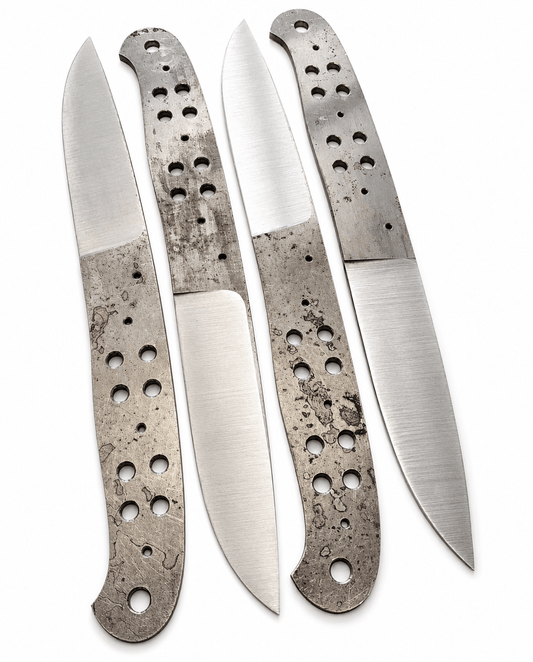
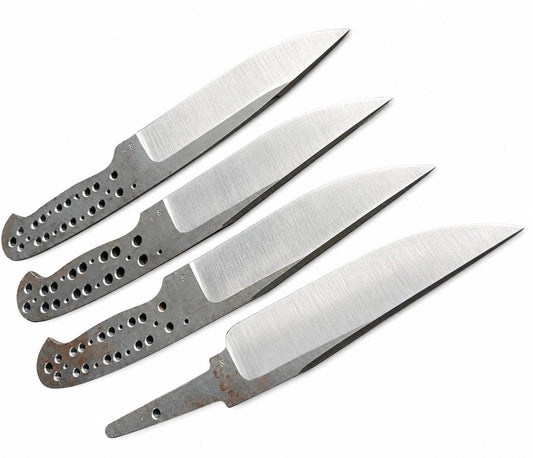
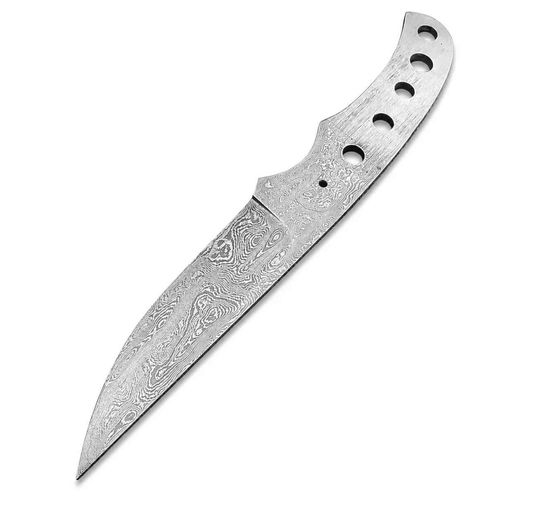
Holes or cutouts are machined into the tang to save weight while keeping the full outline. They also give the epoxy more surface to grip.
Whatever the shape, check the pin holes before you order scales and hardware. Hole count, diameter and spacing differ from blank to blank, and a hardened blank is very hard to drill afterward without carbide bits.
Blade Profiles on Full Tang Blanks
Hunting Profiles
A drop point has a spine that curves down to a strong tip and a long belly for field dressing and skinning. A spear point centers the tip for controlled piercing and general camp use. Skinner profiles have a short, upswept blade for long strokes under the hide. See more in our hunting knife blanks.
Bowie and Clip Point Profiles
Bowie blanks have a longer blade and a clip point, where the spine is cut away near the tip to make it finer. A full tang gives these big blades the support they need. Browse our Bowie knife blanks for larger builds.
Bushcraft, Tracker and Seax Profiles
Bushcraft blanks have straighter edges and thicker spines for carving, feathering sticks and batoning firewood. Tracker profiles combine a curved belly, a chopping section and spine notches on one blade. A seax has a long, straight back that angles down to the tip, a shape taken from early medieval Northern European knives.
Kitchen and Fillet Profiles
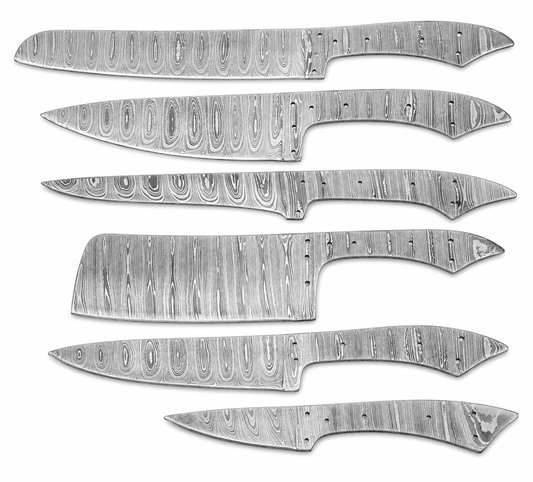
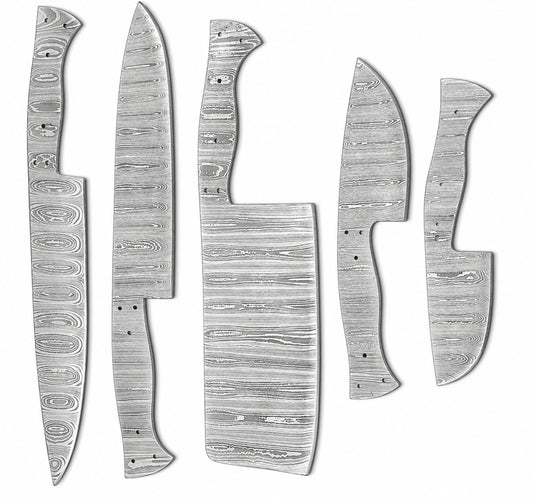
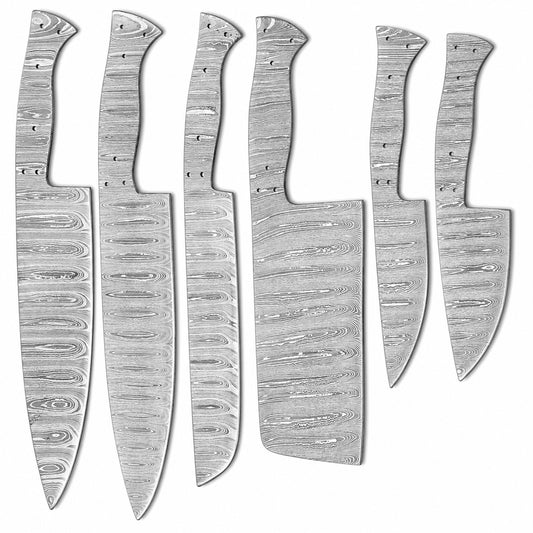
Full tang chef, santoku, nakiri and cleaver blanks let you build kitchen knives with scales sealed against water. Fillet blanks are thinner and more flexible for working along fish bones. On kitchen builds, a tapered tang helps the knife feel lively in the hand.
Choosing a Steel for Your Blank
Steel decides how the finished knife sharpens, holds an edge and handles moisture, so match it to how the knife will be used.
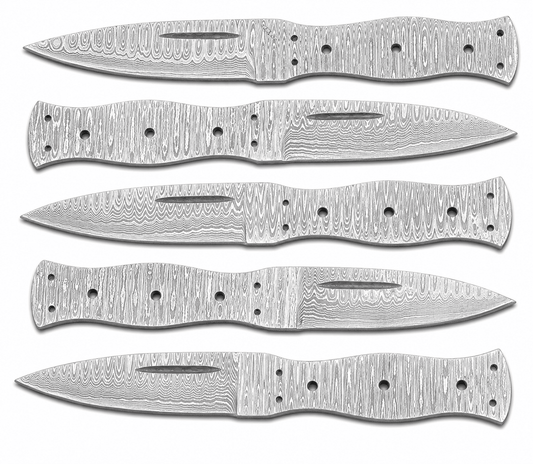
Damascus blanks are pattern-welded from layers of different steels and etched to bring out the pattern. They sharpen like the carbon steels in them, need the same rust care and make a striking finished piece. Compare patterns in our Damascus knife blanks.
1095 and other high carbon steels take a keen edge and are easy to sharpen in the field. They aren't stainless, so keep them dry and oiled, and expect a gray patina with use. Our carbon steel knife blanks cover these steels.
440C is a high-chromium stainless steel that resists rust far better, which suits fishing, kitchen and wet-weather knives. D2 is a high-chromium tool steel known for long edge retention and good stain resistance, though it's slower to sharpen.
Handles, Pins and Finishing
Full tang blanks give you a wide choice of scale materials. Micarta and G10 are waterproof and grip well when wet. Stabilized wood has a warm look and resists moisture. Bone, horn and stag give a traditional finish. Some makers add a thin liner between steel and scale for a colored line around the handle.
Scuff the tang and the back of each scale with coarse sandpaper, clean off oil with acetone and use a slow-setting epoxy. Plain pins, Corby bolts or mosaic pins then lock the scales mechanically, so the handle stays tight even if the glue ages. Round the edges of the scales once the epoxy cures so the grip has no hard corners.
Single Blanks or Maker Lots
A single blank or a matched pair is enough for one project or a test of a new handle material. Five- to eight-piece sets let you try several handle combinations on the same profile. Larger lots of 10 to 50 pieces suit workshops, makers who sell finished knives and anyone keeping stock for future builds.
Before ordering, compare the overall length, blade length, steel, tang shape, pin holes, edge condition and heat-treatment status on each listing, then pick the full tang blank that fits your next build.