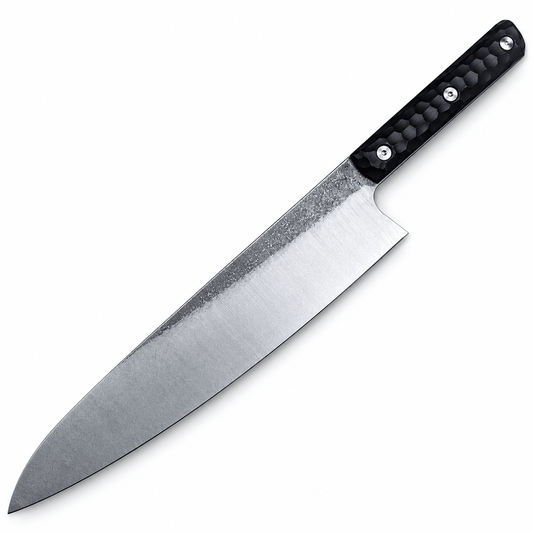
What Is a Gyuto Knife?
Gyuto means "cow sword", a name that comes from its original use for cutting beef when Western-style cooking spread through Japan. Today the gyuto is the all-purpose knife of the Japanese kitchen, used for meat, fish, vegetables and herbs. It follows the general shape of a Western chef knife but is thinner, lighter and made with harder steel, so it takes a finer edge and cuts more cleanly.
Gyuto vs Western Chef Knife
A Western chef knife has a thicker spine, a heavier blade and a deeply curved belly made for rocking cuts. A gyuto has a flatter belly and a finer, more pointed tip, which suits push cuts, pull cuts and precise slicing as well as gentle rocking. The thinner blade glides through food instead of wedging it apart, so onions, herbs and soft proteins cut cleanly without bruising. The trade-off is that a gyuto's harder, thinner edge needs more careful use: it isn't meant for bones, frozen food or twisting cuts. For heavier Western blades, see our chef knives.
Gyuto vs Santoku
Both are all-purpose Japanese knives, but the gyuto is longer, with a pointed tip and a gentle curve. The santoku is shorter and taller, with a flatter edge and a rounded tip. A gyuto handles larger ingredients, long slicing cuts and fine tip work. A santoku is compact and easy to control for quick push cuts. Many cooks choose a gyuto as their main knife and add a santoku or petty knife for smaller jobs.
Gyuto Sizes
Gyuto knives are usually measured in millimeters:
- 180 mm (about 7 inches): compact and nimble, good for smaller kitchens and smaller hands.
- 210 mm (about 8 inches): the most popular size and the best all-round choice for home cooks.
- 240 mm (about 9.5 inches) and longer: more reach for large vegetables, roasts and long slicing cuts. Popular with experienced cooks and chefs.
Tip Shapes: Classic and K-Tip
A classic gyuto has a spine that curves gently down to a fine point. A K-tip, or kiritsuke-style tip, has an angled, clipped point that gives a stronger tip and a flatter edge near the front, which helps with precise cuts and scoring. The choice comes down to how you cut: a classic tip suits rocking and slicing, and a K-tip suits push cuts and detail work.
Steels for Gyuto Knives
High carbon steels such as 1095 take an extremely sharp edge and are easy to sharpen on a whetstone, but they build a patina and need to be dried after use. Stainless steels such as 440C and VG10 resist rust better and need less care, which suits a busy home kitchen. Damascus gyuto knives use welded layers of steel for a flowing pattern, often around a hard cutting core. Whatever the steel, a good heat treatment is what lets a gyuto hold its thin, fine edge.
Blade Finishes
Gyuto knives come in several finishes that change both looks and performance. A polished or satin finish gives a clean, classic look. A stonewashed finish has a textured, matte surface that hides scratches. A black forged or kurouchi finish leaves the dark scale from forging on the upper blade for a rustic look and some rust protection. A hammered, or tsuchime, finish adds small dimples that help food release from the blade.
Handles: Wa and Western
Traditional Japanese wa handles are octagonal or D-shaped and fitted over a hidden tang. They're light and move the balance toward the blade, which many cooks like for precise cutting. Western-style handles are full tang with riveted scales and feel heavier and more familiar to Western cooks. Wood, stabilized wood, Micarta and G10 are all common. G10 and Micarta stand up best to water and daily use.
How to Use a Gyuto
A gyuto works best with push cuts, where the blade moves forward and down through the food, and pull cuts, where you draw the blade back for clean slices of meat and fish. You can rock it gently for herbs, but its flatter profile rewards a more forward motion. Let the sharp edge do the work rather than forcing it.
Caring for a Gyuto Knife
Wash your gyuto by hand and dry it straight away, especially carbon steel and Damascus. Use a wood or soft synthetic cutting board. Avoid bones, frozen food and twisting cuts, which can chip a thin, hard edge. Store it in a saya, block or knife roll, and sharpen on whetstones to keep the fine edge. A gyuto also pairs well with a paring or petty knife; see our kitchen knife sets for complete setups.
Compare sizes, tip shapes and steels above to find the gyuto that fits the way you cook.