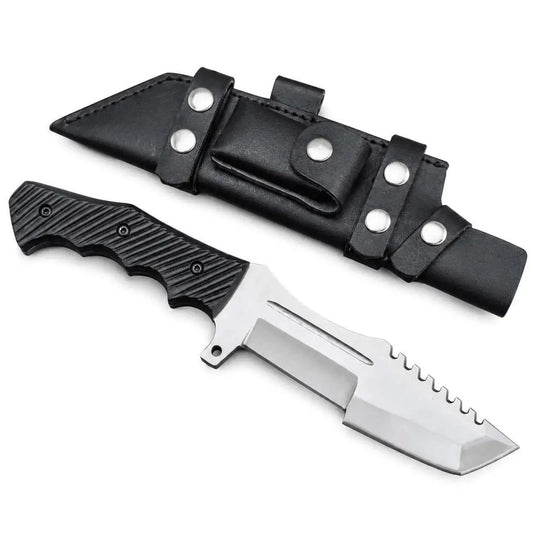
What Makes a Tracker Knife Different
A tracker knife is easy to recognize. Instead of one continuous edge, the blade is divided into working sections, each shaped for a different job. The design is credited to wilderness instructor Tom Brown Jr., who wanted one blade that could stand in for a small hatchet, a saw and a carving knife. That is why tracker knives look so different from a Bowie or a standard hunting knife, and why each section matters when you compare them.
The Sections of a Tracker Blade
The curved, weighted front section is for chopping, much like a small hatchet. The straight main edge behind it handles carving, splitting and general cutting. Near the handle, a curved rear section is shaped for rounding wood, such as a bow-drill spindle, and for controlled cuts through hide. Along the spine, many tracker knives carry saw teeth for notching and cutting small branches. The flat back of the blade can be tapped with a wooden baton to drive the edge through wood for a clean split. Knowing these sections makes it much easier to judge how well a particular tracker knife fits the way you will use it.
Tom Brown–Style Tracker Knives
The tracker profile became widely known after it appeared in the 2003 film The Hunted, and that design is what most people picture when they search for a tracker knife. Several knives in this collection follow that Tom Brown–style profile, including a version with a D2 tool steel blade. They keep the familiar outline, with the chopping belly, straight edge and notched spine, while differing in steel, finish and handle material. If you want the classic look first, start with these and compare the blade finish and the sheath. For more knives tied to the screen, see our movie replica knives.
Sawback Tracker Knives
Sawback versions have saw teeth along the spine, the feature that most clearly separates a working tracker from a plain fixed blade. The teeth are meant for small jobs: cutting notches, trimming thin branches and scoring material before snapping it. They don't replace a folding saw on thicker wood. This collection includes several sawback trackers, from a large sawback fixed blade with a black handle to the sawback tracker knife with a leather sheath and the custom survival tracker with a sawback blade. When comparing sawbacks, look at the length of the toothed section and how the spine sits under your thumb for carving.
Blade Finishes: Hamon, Acid Washed, Hammered and Patterned
Finish changes both the look of a tracker knife and how it ages. A hamon finish shows a visible wavy line along the blade, a traditional look prized by collectors. An acid washed finish darkens the steel and gives it a worn, rugged character that also hides light scratches. A hammered finish leaves the blacksmith's texture on the flats for a rustic, handmade look. This collection includes each of these, plus a tracker with a skull-pattern blade for buyers who want something less conventional.
Damascus is another finish that suits the tracker profile well, because the pattern-welded layers run across the wide blade. A Damascus tracker gives the same working shape with a more decorative surface, though it needs the same care as any carbon-rich steel.
Steel Choices for Tracker Knives
Many knives here use carbon or high carbon steel. Carbon steel takes a keen edge and is easy to sharpen in the field, which suits a chopping and carving blade. The trade-off is rust: it needs to be dried after use and given a light coat of oil. A few trackers use D2 tool steel, a semi-stainless steel with high chromium content. D2 resists rust better and holds an edge longer, but it is harder to sharpen than plain carbon steel. If you'll use your tracker outdoors often, carbon steel is the easier one to maintain an edge on. If it will mostly sit on display or see damp conditions, D2 asks for less attention.
Handles, Tang and Size
A tracker knife is chopped with, batoned and gripped in different positions, so the handle and tang matter. Full tang construction, where the steel runs through the entire handle, adds strength for chopping, and some knives in this collection are listed as full tang. For handles, Micarta is made from resin-bonded cloth and stays grippy when wet, wood gives a warm, traditional look and feel, and stag adds natural texture with a classic collector appeal.
Tracker knives are larger and heavier than most fixed blades because the front section needs weight to chop. A large tracker knife has more chopping power, while a shorter one is easier to carry and control for carving. Check the overall length and the blade length on each listing before choosing.
Tracker Knife vs. Bushcraft, Hunting and Bowie Knives
A tracker overlaps with several other knife types but isn't quite any of them. A typical bushcraft knife has a shorter, simpler blade focused on carving, while the tracker adds chopping weight and a saw. A hunting knife is built mainly for field dressing and skinning, while the tracker trades some of that finesse for versatility. A Bowie has a long clip point blade for general cutting but no separate sections. If one of those suits you better, browse our hunting knives or camping knives.
Leather Sheaths and Care
Many trackers here come with a leather sheath that holds the wide blade securely. Leather holds moisture, so take the knife out of the sheath for long-term storage. Wipe the blade dry after every use, oil carbon steel lightly and sharpen each section with the right tool: a flat stone for the main edge and a rod or small file for the curved areas. Kept that way, a tracker knife stays sharp and keeps its finish, whether it lives on a shelf or in your pack. Browse the collection above to compare profiles, finishes and handles.