What Is a Santoku Knife?
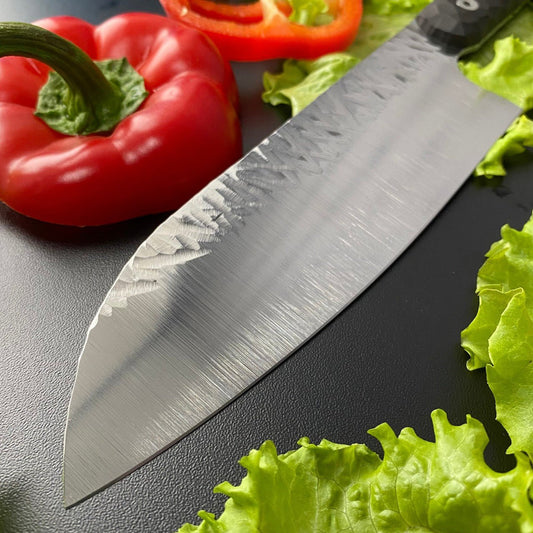
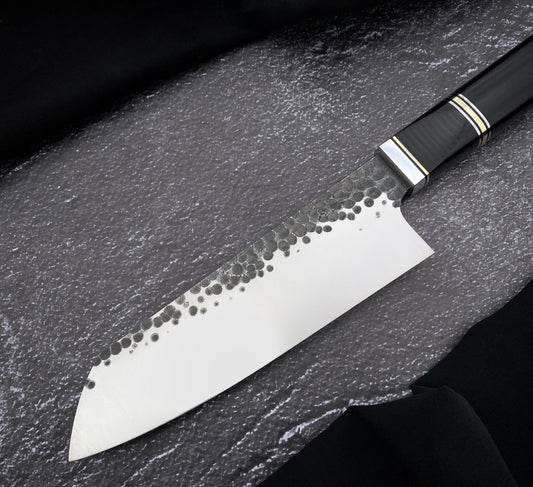
Santoku is usually translated as "three virtues", which refers either to the three foods it handles, meat, fish and vegetables, or to its three main cuts: slicing, dicing and mincing. It became popular in Japanese homes in the mid-1900s as an all-purpose knife, and today it's one of the most widely used kitchen knives in the world. Its shape is easy to recognize: a straight, flat edge, a tall blade and a spine that curves down to a rounded "sheepsfoot" tip.
Santoku vs Chef Knife
A chef knife is longer, usually around 8 inches, with a curved belly built for rocking cuts and a pointed tip for detail work. A santoku is shorter, usually 5 to 7 inches, with a flatter edge built for straight push cuts, where the blade moves down and forward through the food. The santoku's height gives your knuckles clearance from the board and makes it easy to scoop chopped food. Many cooks find a santoku lighter and easier to control, especially for vegetables. Others prefer the reach and rocking motion of a chef knife, and plenty of kitchens keep both. For a longer Japanese chef knife, see our gyuto knives.
What a Santoku Is Used For
A santoku handles most everyday prep: slicing onions, dicing carrots and potatoes, mincing garlic and herbs, slicing boneless chicken and fish, and cutting cheese. Its flat edge makes clean, even slices that suit stir-fries, salads and sushi rolls. It isn't made for bones, frozen food or very hard squash. For those jobs, use a cleaver or a heavier chef knife.
Santoku Sizes
- 5 to 5.5 inches: a compact, nimble size for small produce, small kitchens and quick tasks. Many cooks use one alongside a larger knife.
- 6.5 to 7 inches: the most popular size and the best all-round choice for home cooks.
- 8 inches: more reach for larger vegetables and bigger batches, closer to a chef knife in size.
Hollow Edge, Hammered and Plain Blades
Many santoku knives have a hollow or granton edge: a row of shallow scallops along the side of the blade. They create small air pockets that help stop thin slices of potato, cucumber or cheese sticking to the steel. Hammered, or tsuchime, blades use small dimples to do the same job and add a hand-forged look. A plain, smooth blade is easier to clean and sharpen and gives a classic look.
Steels for Santoku Knives
Stainless steels such as 440C and VG10 resist rust and need little care, which makes them practical for an everyday home knife. High carbon steels take a very sharp edge and are easy to resharpen, but they need to be dried after use and will develop a patina. Damascus santoku knives use welded layers of steel for a flowing pattern, often around a hard cutting core.
Handle Materials
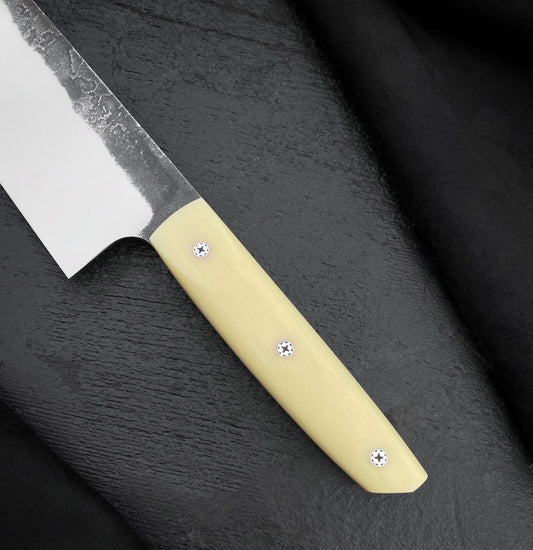
Santoku knives come with traditional Japanese wa handles, which are octagonal or D-shaped and light in the hand, or Western-style handles with full tang construction and riveted scales. G10 and Micarta are tough, water-resistant synthetics that keep their grip when wet. Wood brings warmth and natural grain. Bone and horn add a classic, handcrafted look.
How to Use a Santoku
The santoku is built for the push cut: start with the tip slightly raised, then move the blade forward and down through the food in one smooth stroke. Because the edge is flat, it meets the board along its whole length, which gives clean, even cuts. Curl your guiding hand's fingertips under and use your knuckles to guide the side of the blade. You can still rock a santoku a little for herbs, but a straight push cut makes the best use of its shape.
Caring for a Santoku Knife
Wash your santoku by hand and dry it straight away. Use a wood or soft synthetic cutting board, never glass or stone. Store it in a block, on a magnetic strip or in a sheath so the edge stays protected. Hone regularly and sharpen on a whetstone when it starts to drag. A santoku pairs well with a paring knife and a bread knife; see our kitchen knife sets for complete setups.
Compare the sizes, blades and handles above to find the santoku that fits the way you cook.